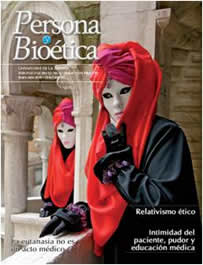
Ethical relativsm
Abstract
The article offers a general description of the whirlwind sparked during slightly more than two centuries – as of the XVIII century – by a philosophical doctrine that began with the skepticism of the pre-Socratic era, briefly revived during the Enlightenment by Michel de Montaigne and others, to emerge solidly with the insular empiricists: Locke, Berkeley and Hume, who imposed their thinking to the point where it remains buoyant today, with numerous supporters among philosophers of three nonrealist lines of thinking on bioethics that are currently in vogue: sociobiologist, utilitarian pragmatic and radical liberal.
Downloads

How to Cite
Issue
Section
License
Authors who publish with this journal agree to the following terms:
This journal and its papers are published with the Creative Commons License Attribution-NonCommercial-NoDerivatives 4.0 International (CC BY-NC-ND 4.0). You are free to share copy and redistribute the material in any medium or format if you: give appropriate credit, provide a link to the license, and indicate if changes were made; don’t use our material for commercial purposes; don’t remix, transform, or build upon the material.